

Q. Suspected VA medical malpractice can involve both a disability benefits question and a negligence claim. Can veterans seek both remedies for the same injury?
A. Yes. Veterans can bring a Section 1151 claim and a Federal Tort Claims Act (FTCA) claim for the same injury. Section 1151 provides qualifying disability compensation; the FTCA provides damages for negligence. The two claims follow separate procedures and standards of proof, and federal law prevents duplicate recovery for the same disability or death.
Q. How do the two VA medical malpractice remedies differ?
When you file a Section 1151 claim for VA medical malpractice, you ask VA to pay compensation for a qualifying additional disability or death as if it were service-connected. Congress established this route in 38 U.S.C. § 1151, and 38 C.F.R. § 3.361 spells out its implementing rules.
| Issue | Section 1151 claim | FTCA claim |
|---|---|---|
| Eligibility | Eligible veterans harmed by qualifying VA care; qualifying survivors after a covered death. | Injured claimants or authorized representatives whose claims fall within the FTCA’s permission to sue. |
| Required showing | Qualifying additional disability or death caused by VA care through statutory fault or an event not reasonably foreseeable. | Negligence causing injury, assessed under governing state law and federal statutory rules. |
| Available remedy | Disability compensation or qualifying survivor benefits. | Money damages for compensable losses, subject to governing law. |
| Administrative process | A VA benefits claim, followed by benefits review or appeal if necessary. | An administrative tort claim to the responsible agency before an eligible federal lawsuit. |
For VA medical malpractice, seeking Section 1151 disability benefits doesn’t replace presenting a separate FTCA administrative claim for damages to VA before filing a lawsuit.
An FTCA judgment concerning the same disability or death triggers an offset against Section 1151 compensation under 38 U.S.C. § 1151(b); a settlement or compromise does too. VA withholds covered compensation until it satisfies the required offset. Check the calculation against the actual recovery documents and VA’s decision on benefits.
Q. What evidence is needed for a VA malpractice claim?
Your evidence for a VA malpractice claim must establish more than a bad result. VA uses its Section 1151 regulation to compare your condition before and after the disputed care. A decline after treatment alone doesn’t show that the treatment caused an additional disability.
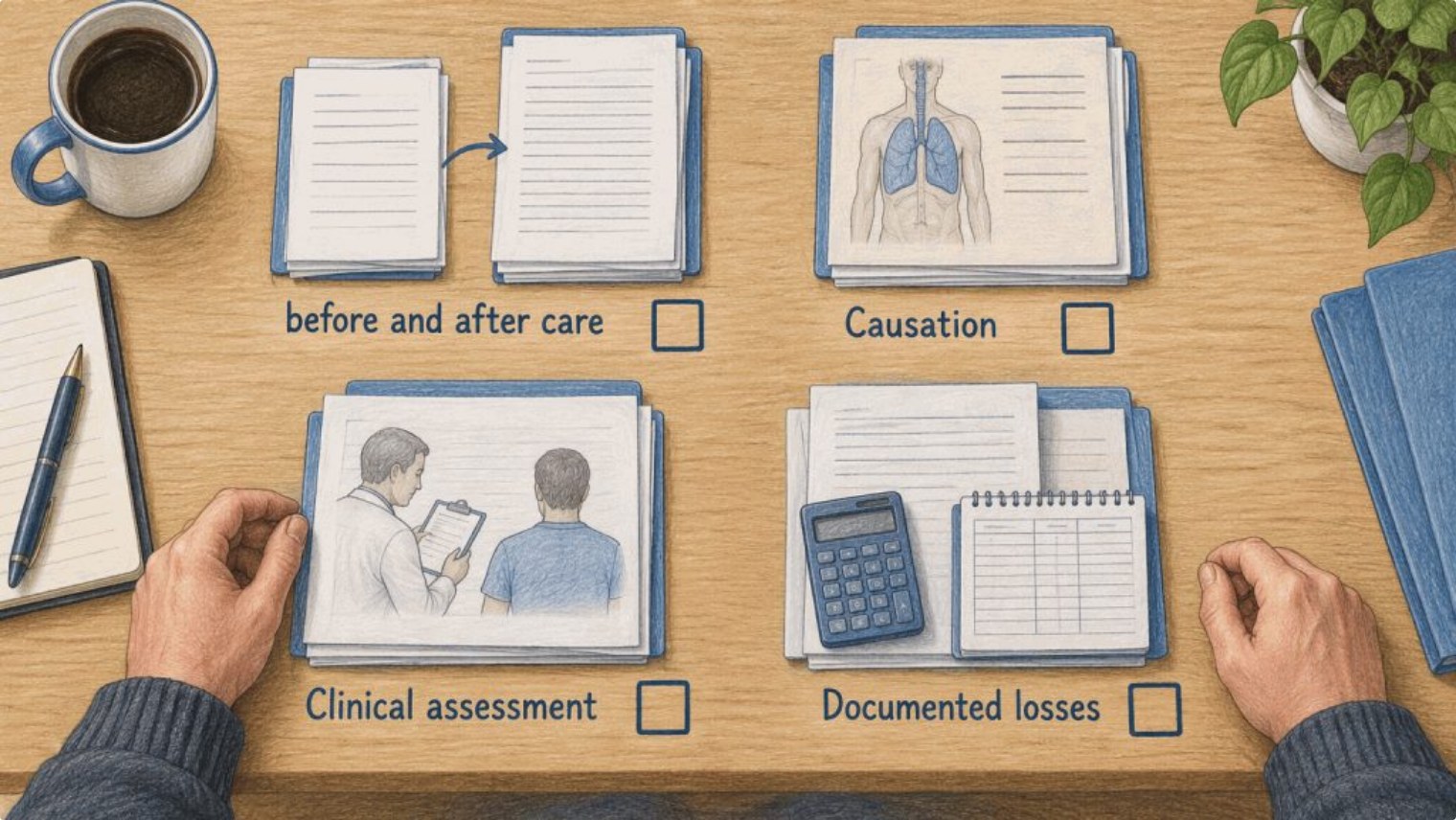
- Your condition before and after care: Earlier records and later findings can document a change, such as a new loss of hand strength.
- Causation: A medical explanation should link the harm to the disputed care, not to the disease’s expected progression.
- Clinical assessment: Medical evidence should cover the standard of care. A Section 1151 opinion should discuss foreseeability if the claim rests on that basis.
- Documented losses: Keep records of ongoing treatment and work restrictions, along with earnings records if you’re seeking lost income.
AHRQ PSNet’s summary of Peard and colleagues’ 2023 VA urology study identified equipment problems and retained surgical items as factors contributing to adverse events. A reported event still requires an individual assessment linking the care to the patient’s injury.

An adverse outcome can occur despite proper treatment. Your evidence for an FTCA negligence claim must show a breach of the governing standard of care and connect that breach to the injury you’re seeking damages for.
Steps to preserve both claims and filing deadlines
Step 1: Document the injury and obtain the relevant medical records
Request the treatment record and put together a dated timeline to compare the disputed care with when the injury began. Include records of later care outside VA. Save patient-portal messages and appointment notices, especially if you’re alleging a delayed diagnosis. Record changes in your daily function using specific examples, such as difficulty dressing after a procedure.

Step 2: File the Section 1151 benefits claim and present the FTCA administrative claim separately
Submit the benefits application separately from the administrative tort claim. They follow different processes within VA. State clearly that your benefits application seeks Section 1151 compensation for an additional disability that VA care caused.
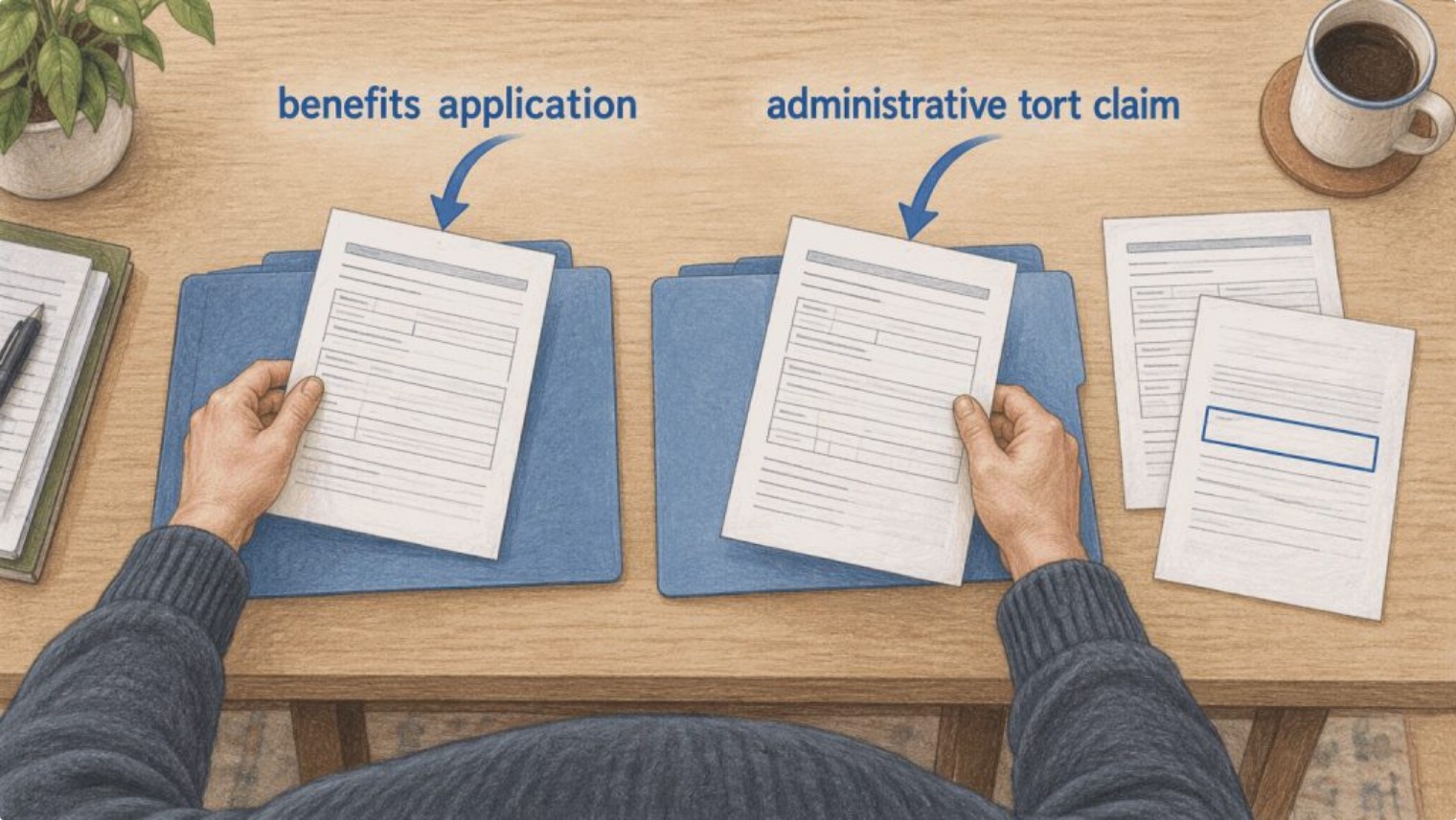
Claimants commonly use Standard Form 95 (SF-95) for FTCA presentment. Describe the treatment you’re challenging and the injury it caused, and demand a specific dollar amount. A patient-advocate complaint or safety report can’t replace the administrative damages claim. Keep a full copy and proof that the agency received it.
Step 3: Complete agency review before filing an FTCA lawsuit
Give the agency the opportunity that 28 U.S.C. § 2675(a) requires before you sue. You can generally proceed after a final denial or after six months if the agency hasn’t taken final action. That requirement applies to the administrative tort claim, not to finishing a separate benefits appeal.
rilawyersweekly.com reported on October 27, 2026, that the U.S. District Court in Rhode Island dismissed an FTCA complaint without prejudice because the patient’s SF-95 described spinal surgery but didn’t mention the chiropractic treatment later challenged in court. The dismissal shows that submitting a form alone doesn’t establish exhaustion for an incident your administrative claim doesn’t mention.
Step 4: Track the denial date, limitation periods, and any compensation offset
Calendar the accrual date and the date the agency mails any final denial. Keep the notice and envelope to calculate the filing periods. You generally must present the claim within two years after accrual under 28 U.S.C. § 2401(b) and file a lawsuit within six months after the agency mails its final denial.

The accrual date can depend on when you knew or should have known about the injury and its cause, not on when someone called the treatment negligent. Don’t assume that filing under Section 1151 pauses the FTCA clock. Keep any benefits award and tort recovery documents together to calculate the offset.
Other questions about pursuing both remedies
Q. Does a veteran sue the VA doctor personally?
A. The FTCA generally makes the United States the defendant, not the individual doctor, for covered negligence by a federal employee acting within the scope of employment. That protection doesn’t remove your claim against the government. A clinician’s independent contractor status can change the analysis.
Q. Which claims present the greatest proof difficulties?
A. The evidence determines how hard the claim is to prove, not the claim’s label. Disputed causation can be especially hard to prove when a preexisting illness could explain the decline. You need medical evidence that separates harm the care caused from deterioration due to that illness.
Q. When might malpractice litigation be worthwhile?
A. Litigation may be worth considering when medical evidence supports negligence and the injury causes substantial losses you can recover, such as continuing care costs. Weigh likely recoverable damages against expert testimony costs and the effect of any Section 1151 offset.
Q. Should you obtain advice before submitting a claim?
A. Early advice helps if you may pursue both remedies or the injury’s cause is uncertain. A lawyer who knows FTCA claims can assess presentment and damages. A VA-accredited representative can help you with the separate benefits application or appeal.
Q. Do physician departures or staffing shortages prove malpractice?
A. Staffing numbers alone don’t tell you why individual doctors leave VA or prove that treatment was negligent. A staffing concern matters to your claim when evidence links a specific lapse to your injury, such as a test result no one addressed during a vacancy.
Q. How does VA’s emergency-care notification rule differ?
A. VA’s 72-hour notification rule covers notifying VA about emergency treatment at a non-VA facility for coverage purposes. It isn’t a malpractice filing deadline, and it doesn’t replace FTCA presentment. Notification by itself also doesn’t guarantee that VA will pay the emergency-care bill.
General clarification: You need separate filings to pursue both remedies, and you must account for how each claim affects the other. Keep a deadline calendar alongside your medical records, and seek help tailored to your treatment history before you accept a settlement.