
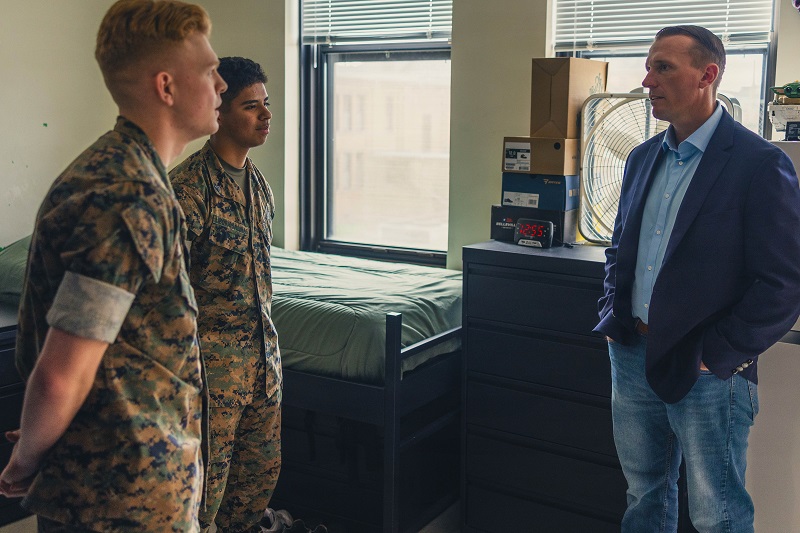
NOVEMBER 14, 2026 – After three weeks of leading the Barracks Task Force and visiting several military bases, Dakota Meyer, Medal of Honor recipient, understands the housing challenges service members are facing.
“We have service members living in conditions they should have never spent one night in, much less months, and in some cases, years,” he said. “That ends now.”
Secretary of War Pete Hegseth signed a memo Nov. 10 directing the services to ensure no service member is left in barracks without hot water, functioning climate control, secure doors, or where mold is present.
A Government Accountability Office investigation in 2023 revealed that service members were forced to live in barracks with sewage overflows, inoperable fire systems, dangerous gas leaks and rodent infestations.
“I’ve lived in old facilities, but those facilities were maintained to a level that was clean, safe and comfortable,” Meyer said. “That’s not what I’m seeing as I’m going around to military installations right now.”
Hegseth’s memorandum gave the military departments five days to validate compliance with an Oct. 6 memo issued by Assistant Secretary of War for Energy, Installations and Environment Dale Marks, the senior official responsible for barracks modernization.
Each department is required to ensure housing is either brought into compliance with the War Department’s standards within 24 hours, without exception, or relocate affected service members until repairs are made. Those members would be temporarily moved to other housing or to hotel accommodations.
Hegseth’s directive said that unit integrity, room availability, manpower shortages, maintenance delays, lack of funding or conflicting policies don’t justify occupancy in unacceptable housing. Any barrier to rapid relocation will elevate through the military departments to the Barracks Task Force.
Meyer, who’s also a sergeant in the Marine Corps Reserve, stressed that commanders are responsible for the welfare of their service members.
“Inability to make repairs, lack of manpower, or delays in getting something fixed do not relieve commanders of their responsibility,” he said. “If the room cannot be fixed, move the service member.”
Within 10 days of the memorandum, the secretaries of the Army, Navy and Air Force will report to the Barracks Task Force the number of service members affected by emergency conditions, as well as the number of relocations completed, rooms vacated, corrective actions taken and projected timelines for returning affected housing.
Meyer said the responsibility to take care of members doesn’t change because a solution becomes difficult.
“Our service members deserve a place that is clean, safe and comfortable,” he said. “They kept their promises. Now we’re going to keep ours.”
By Douglas E. Jessmer
Pentagon News